Plain-English guide teaching beginners how to find posting times that match their audience, using simple analytics and lightweight experiments rather than generic “best times” lists. Includes a repeatable testing plan and explains how KOLSprite can speed data collection.
 +
+
Intro — Why everyone’s “best time” advice fails new creators
Advice lists are convenient, but they ignore two realities: timezones and audience habits. Your ideal time is the hour when your audience is active and receptive. For buyers, that’s often different than for general entertainment. Learn to test for your audience.
Section 1 — The basic logic behind “best time”
A good posting time maximizes two things:
- Immediate view velocity — the first few minutes matter for algorithmic promotion.
- High-intent viewers online — viewers who are likely to save, comment, or click links.
When viewers are active and interested, your content gets a better chance at distribution.
Section 2 — 2-week test to find your prime window (step-by-step)
Week 1 — Broad sampling:
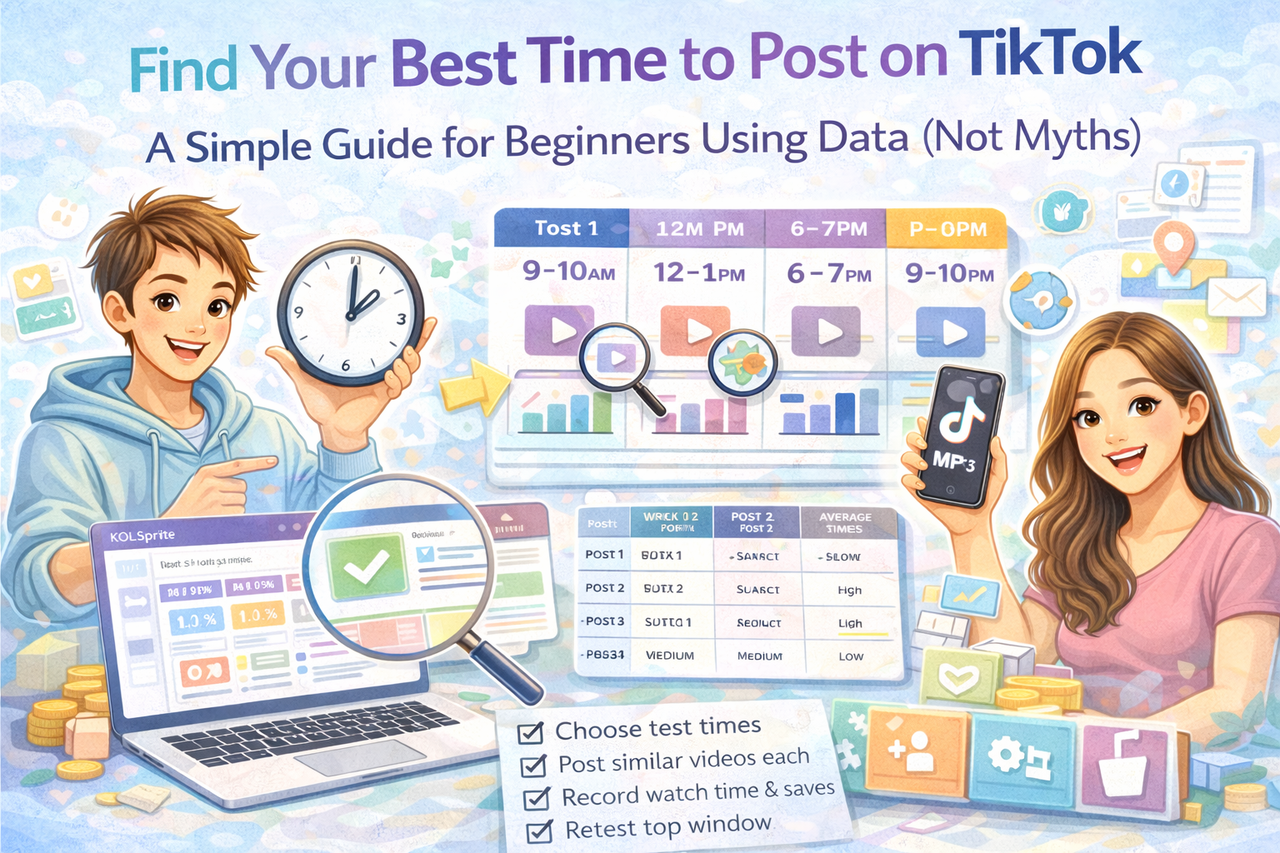
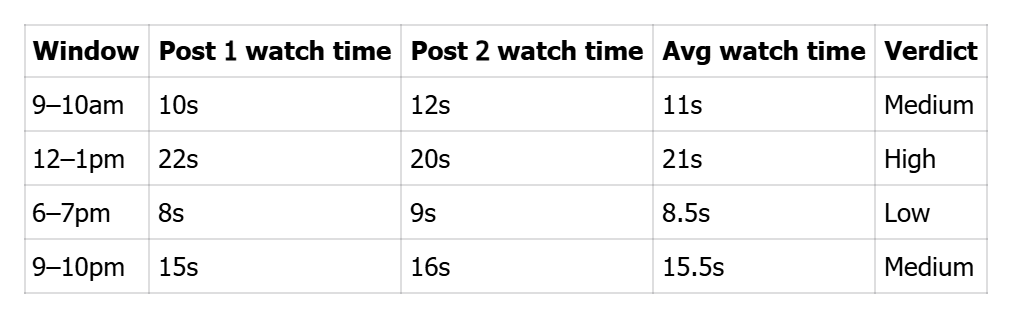
- Pick 4 posting windows (e.g., 9–10am, 12–1pm, 6–7pm, 9–10pm).
- Post one similar video in each window across several days. Keep the content and captions consistent.
Week 2 — Focused retest:
- Pick the top 2 windows from Week 1 and test 3 additional videos each.
- Track watch time, completion rate, saves, and click-through (if available).
Decision rule: Use the window with consistently higher watch time and saves as your prime slot. If two windows are close, use both on alternating days.
Section 3 — Common pitfalls and how to avoid them (EEAT)
- Mistake: Changing content between test posts. Keep visuals and captions similar to isolate time as the variable.
- Mistake: Small sample size. Minimum of 3 posts per test window gives more reliable signals.
- Mistake: Ignoring timezone differences. If your customers are international, prioritize their timezone.
Section 4 — How KOLSprite speeds the test and multiplies insights
KOLSprite helps by:
- Aggregating engagement metrics across posts faster than manual checks.
- Allowing you to compare similar videos from competitors by posting hour to spot industry-specific active windows.
- Flagging patterns like “this niche performs better at lunchtime in Brazil” so you can adjust posting schedule geographically.
This reduces guess-and-check to a clear evidence-based schedule.
Table — Simple test matrix example
 +
+
Checklist — 2-week posting time test
- ⬜ Choose 4 windows to test
- ⬜ Post 3 similar videos per window (spread across days)
- ⬜ Record watch time and save for each post
- ⬜ Pick top window and retest with 3 more videos
CTA
Stop relying on generic schedules. Use a data-driven test and, if you want to speed it up, use KOLSprite to collect and compare engagement across posting windows in minutes.


 Refer & Earn